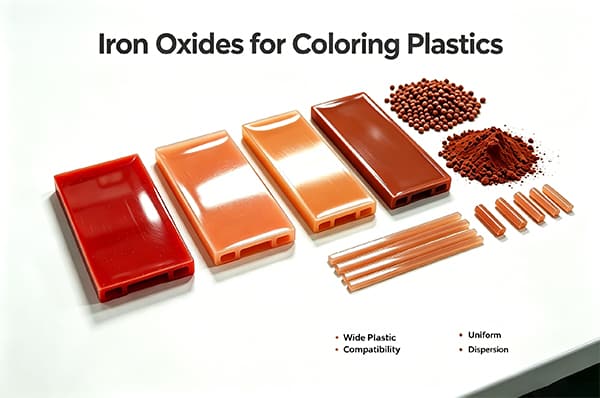
Iron oxides are among the most widely used inorganic pigments for coloring plastics because they’re stable, inexpensive, non-toxic, and resistant to heat and UV exposure.
Iron oxides are among the most widely used inorganic pigments for coloring plastics because they’re stable, inexpensive, non-toxic, and resistant to heat and UV exposure. They’re commonly used in applications where long-term color durability matters—like construction plastics, outdoor products, packaging, and automotive parts.
Common Iron Oxide Pigments in Plastics
There are three primary types used as plastic colorants:
- Red iron oxide (Fe₂O₃) – gives earthy reds to brick tones
- Yellow iron oxide (hydrated FeOOH) – produces yellow to brown shades
- Black iron oxide (Fe₃O₄) – provides deep black or dark gray tones
- (Blends of these are often used to create browns, tans, and custom earth tones.)
Why They’re Used in Plastics
Iron oxides are popular because they:
- Withstand high processing temperatures (often >200–300°C depending on grade)
- Are UV and weather resistant, so colors don’t fade outdoors
- Are chemically stable, not reacting with most polymers or additives
- Are non-migratory, meaning they don’t bleed or migrate in the plastic
- Are non-toxic and regulatory-friendly, often compliant with food-contact requirements (depending on grade and supplier certification)
Typical Plastics That Use Iron Oxides
They work well in both thermoplastics and thermosets, including:
- Polyethylene (PE)
- Polypropylene (PP)
- PVC
- Polystyrene (PS)
- Engineering plastics (ABS, PA, PET in some cases)
- Epoxy and polyester resins (especially in construction materials)
Dispersion & Particle Considerations
Performance depends heavily on pigment quality:
- Particle size: finer particles give better tint strength and smoother color
- Surface treatment: helps improve dispersion in hydrophobic polymers
- Agglomeration control: poor dispersion leads to streaking or color inconsistency
Masterbatch form is commonly used (iron oxide pre-dispersed in a carrier resin) to ensure uniform mixing.
Dosage Levels
Typical loading ranges:
- 0.1%–5% for light to medium shades
- 5%–10%+ for strong, opaque colors (especially blacks and deep reds)
Exact levels depend on polymer, thickness, and desired opacity.
Advantages vs Organic Pigments
Compared to organic colorants, iron oxides:
- Are less vibrant but more “earth-toned”
- Have much higher heat and UV stability
- Are cheaper and more durable
- Offer excellent opacity