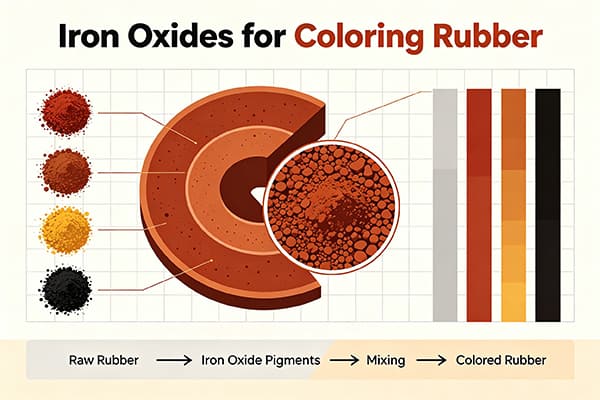
Iron oxides are widely used inorganic pigments for coloring rubber because they’re inexpensive, stable at high temperatures, UV-resistant, and chemically inert in most elastomer systems.
Iron oxides are widely used inorganic pigments for coloring rubber because they’re inexpensive, stable at high temperatures, UV-resistant, and chemically inert in most elastomer systems.
Iron oxide pigments typically refer to three main types used in rubber compounding:
- Red iron oxide (Fe₂O₃, hematite) – the most common; gives strong red to reddish-brown tones
- Yellow iron oxide (hydrated FeOOH, goethite) – used for yellow to tan shades
- Black iron oxide (Fe₃O₄, magnetite) – provides deep gray to black coloration
Why rubber formulators use iron oxides
Iron oxides are especially popular in rubber products that need long-term durability or outdoor exposure:
- Excellent UV stability: they don’t fade like organic dyes
- Thermal stability: survive typical rubber vulcanization (150–200°C range)
- Chemical resistance: don’t migrate or bleed
- Low cost compared to organic pigments
- Non-toxic and environmentally stable
How they’re used in rubber compounds
In practice, iron oxides are added during mixing on an internal mixer (Banbury) or two-roll mill, often in powder form or as a masterbatch to improve dispersion.
Typical loading levels:
- 1–10 parts per hundred rubber (phr) for coloring
- Higher levels (10–30 phr) when strong opacity or deep coloration is needed
They are compatible with most common elastomers:
- Natural rubber (NR)
- Styrene-butadiene rubber (SBR)
- Ethylene propylene diene rubber (EPDM)
- Nitrile rubber (NBR)
Effects on rubber properties
Iron oxides are relatively “safe” fillers compared to reinforcing agents like carbon black or silica, but they still have subtle effects:
- Mechanical properties: slight increase in hardness and stiffness at higher loadings
- Tensile strength: generally neutral to slightly reduced if poorly dispersed
- Processing: can increase viscosity modestly
- Aging performance: often improved due to UV shielding
Good dispersion is critical—poorly dispersed pigment can cause streaking, weak spots, or color inconsistency.
Practical formulation notes
- Use surface-treated grades if compatibility with polymers is an issue
- Combine with dispersing aids or processing oils for uniform color
- Avoid contamination with moisture in yellow iron oxide grades (can affect processing)
- For precise color matching, blend different iron oxide types rather than overloading one pigment