
High-Grade vs Low-Grade Iron Oxide Pigments — Real-World Performance Differences
Date Published
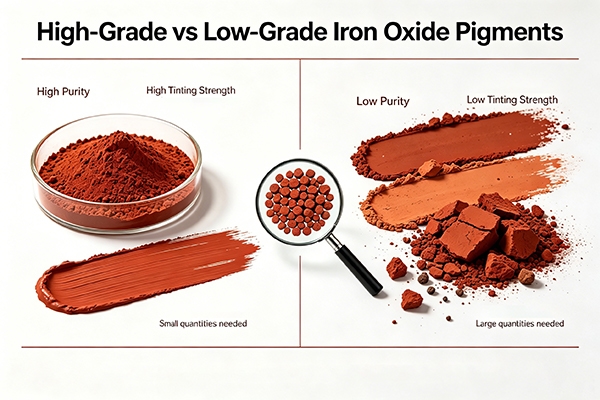
Iron oxide pigments (red, yellow, black, brown) are widely used across coatings, plastics, rubber, construction materials, masterbatches, flooring systems, and inks. In real production and construction environments, the performance gap between high-quality and low-quality materials is often significantly more pronounced than expected.
1. Tinting Strength (Most Visible Difference)
High-Grade Pigments
- Strong tinting strength: 15%–30% less dosage needed for the same color depth
- Lower cost in resins and carriers due to reduced addition levels
- Excellent batch consistency with minimal color deviation
- Clean and pure hue
Low-Grade Pigments
- Weak tinting strength, requiring higher dosage → increased production cost
- Large batch-to-batch color variation, causing patchiness when mixed
- Impure color tones
2. Dispersion Performance (Production Efficiency & Appearance)
High-Grade
- Easily disperses under high-speed mixing or sand milling
- No hard agglomerates or clumps
- No surface defects:
- No pinholes in coatings
- No color spots in plastics
- No speckling in flooring
- Compatible with high-concentration masterbatches
- No clogging in filters or extrusion dies
Low-Grade
- Severe agglomeration and hard lumps
- Requires longer grinding time → higher energy and labor costs
- Finished products show:
- Visible specks
- Surface protrusions
- Frequent equipment clogging and downtime in extrusion processes
3. Weather Resistance, Light Fastness & Chemical Stability
High-Grade
- Light fastness: Grade 7–8
- Outdoor durability: 5–10 years without fading or chalking
- Strong acid/alkali resistance:
- Stable in exterior coatings and cement-based materials
- High-temperature stability:
- No migration or discoloration above 200°C
Low-Grade
- Light fastness only Grade 3–4
- Fading, whitening, and dulling within months outdoors
- Reacts with alkaline cement or acidic primers → discoloration and blotching
- Thermal instability:
- Color shifting, migration, and bleeding in plastics
4. Purity, Heavy Metals & Environmental Compliance
High-Grade Synthetic Iron Oxide
- Low heavy metal content
- Compliant with national and EU REACH standards
- Very low soluble salts and free iron
- No rust or whitening over time
- Suitable for export-grade materials, toys, and regulated applications
Low-Grade (Often Industrial Waste Derived)
- Potential heavy metal contamination → export rejection risk
- High soluble salts → wall efflorescence and cement whitening
- Free iron content causes rust spots and yellow staining over time
5. Oil Absorption Value (Affects Coating Quality)
High-Grade
- Stable and moderate oil absorption
- Predictable viscosity control
- Smooth and glossy paint films
Low-Grade
- Highly unstable oil absorption
- Inconsistent viscosity between batches
- Excess oil demand → brittle, matte, or cracked coatings
6. Moisture, Particle Size & Powder Handling
High-Grade
- Moisture ≤ 0.5%
- Nearly zero residue on 325-mesh sieve
- Excellent flowability and low dust
- Accurate dosing in production
Low-Grade
- Higher moisture content → caking during storage
- Excess coarse particles
- Heavy dust generation and inaccurate dosing
7. Real Application Performance by Industry
Coatings / Exterior Paint
- High-grade: uniform film, UV-resistant, long-lasting color stability
- Low-grade: fading, patchy walls, whitening after rain
Plastics / Masterbatches
- High-grade: smooth extrusion, no black spots, no migration
- Low-grade: surface specks, yellowing, contamination during molding
Rubber / Seals
- High-grade: stable mixing, consistent color, no impact on vulcanization
- Low-grade: surface defects, accelerated aging, weak mechanical properties
Flooring / Cement Products
- High-grade: stable bonding, abrasion-resistant, long-term color stability
- Low-grade: rapid fading, alkaline reaction, surface blotching
Ink / Paper
- High-grade: fine texture, strong coverage, clean printing
- Low-grade: poor coverage, sand-like texture, higher pigment usage
8. Total Cost Comparison (Key Procurement Insight)
Although high-grade pigments have a higher unit price, they typically result in:
- Lower dosage requirements
- Reduced rework and waste
- Less downtime
- Longer outdoor lifespan
👉 Overall lifecycle cost is lower.
Low-grade pigments appear cheaper initially but often lead to:
- Higher consumption
- Production defects and rejections
- Export failures
- After-sales compensation costs
👉 Hidden costs are significantly higher.
9. Simple Field Identification Methods
- Water dispersion test: low-grade leaves sediment and coarse residue
- Outdoor exposure (1 month): low-grade shows obvious fading
- Water soak test: low-grade may release yellowing water or salts
- High-temperature test: low-grade darkens or turns gray quickly
Conclusion
In industrial applications, iron oxide pigment quality directly determines:
- Color stability
- Production efficiency
- Equipment performance
- Outdoor durability
- Compliance and export success
- Total lifecycle cost
High-grade pigments deliver consistent performance and lower long-term costs, while low-grade materials often introduce hidden risks throughout production and end use.