Iron Oxide and Zinc Phosphate in Anti-Rust Paint
Date Published
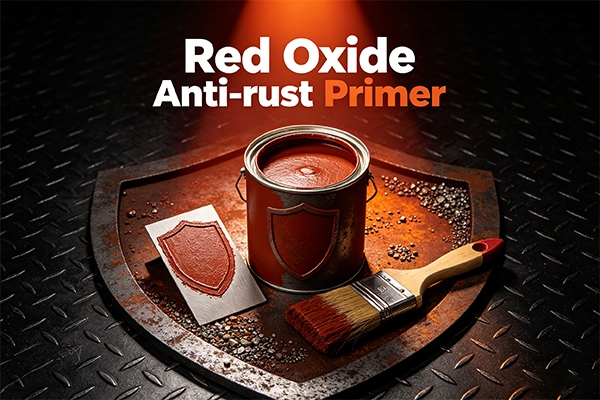
1. Typical Red Oxide Anti-Rust Primer Formulation (Steel)
A red oxide primer is a barrier-type coating designed to block moisture and oxygen from reaching steel. A simplified industrial formulation looks like this:
Pigment package (≈ 40–60%)
- Red iron oxide (Fe₂O₃) – main pigment (color + barrier reinforcement)
- Extenders (fillers) such as:
- Barium sulfate (BaSO₄)
- Talc (Mg₃Si₄O₁₀(OH)₂)
- Calcium carbonate (CaCO₃)
- Optional additives:
- Anti-settling agents (to keep pigments suspended)
Binder / resin (≈ 25–40%)
Depends on system type:
- Alkyd resin (common in traditional primers)
- Epoxy resin (higher-performance industrial systems)
- Acrylic or vinyl systems (specialty coatings)
Solvents (≈ 10–25%)
- Mineral spirits (alkyd systems)
- Xylene / toluene (epoxy systems)
- Glycol ethers (waterborne systems)
Additives (small %)
- Wetting & dispersing agents
- Drying agents (driers like cobalt, manganese salts for alkyds)
- Anti-skinning agents
- Rust inhibitors (sometimes zinc phosphate is added)
How it works in practice
Red iron oxide contributes by:
- Increasing film density (harder for water to pass through)
- Improving UV resistance
- Enhancing mechanical strength of the coating
- Helping stabilize rusted or imperfect steel surfaces
But it is important to note:
Iron oxide itself is not a chemical rust inhibitor—it is mainly a physical barrier pigment.
2. Iron Oxide vs Zinc Phosphate (Key Difference)
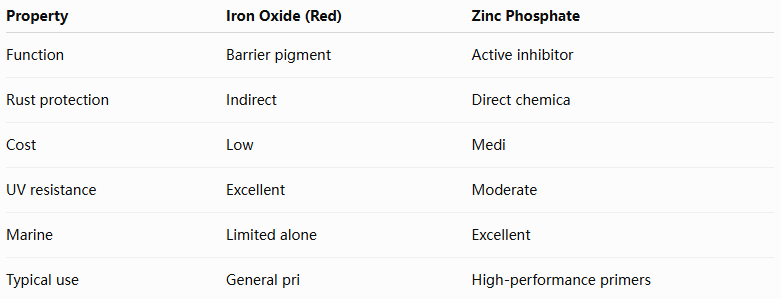
Both are used in anti-corrosion primers, but they function very differently.
🔴 Iron Oxide (Fe₂O₃)
Type: Barrier pigment
Mechanism:
- Blocks moisture and oxygen physically
- Improves coating density and durability
Strengths:
- Very stable and UV resistant
- Low cost
- Non-toxic and environmentally friendly
- Excellent in alkyd-based primers
Limitations:
- Does NOT chemically stop rusting
- Less effective in highly corrosive environments (marine, chemical plants)
⚪ Zinc Phosphate (Zn₃(PO₄)₂)
Type: Active corrosion inhibitor
Mechanism:
- Reacts with steel surface
- Forms insoluble protective phosphate layer
- Passivates metal and slows electrochemical corrosion
Strengths:
- True anti-corrosion functionality
- Works in humid, salty, and industrial environments
- Often used in epoxy primers for heavy-duty protection
Limitations:
- Higher cost than iron oxide
- Requires good dispersion to be effective
- Less UV-resistant on its own (needs topcoat)
3. Quick Comparison
4. How They Are Often
Modern anti-rust
- Iron oxide → improves film strength + barrier properties
- Zinc phosphate → provides chemical
This combination gives dual protection:
- Physical shielding (iron oxide)
- Chemical passivation (zinc phosphate)