Iron Oxides for Coloring Anti-rust Paint
Date Published
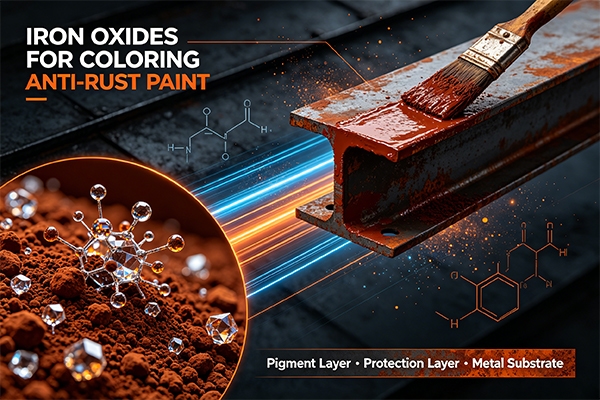
Iron oxides are among the most widely used pigments for coloring anti-rust (anticorrosive) paints because they are stable, inexpensive, non-toxic, and highly resistant to weathering and UV degradation. They don’t just provide color—they also contribute to the protective performance of the coating system.
Common iron oxide pigments used in anti-rust paints
Iron oxide pigments mainly come in three commercial forms:
1. Red iron oxide (Fe₂O₃)
- Also called hematite or “iron oxide red”
- Provides deep red, reddish-brown, or brick tones
- Most widely used pigment in primers and anti-corrosion coatings
- Excellent chemical stability and very low solubility in water
- Acts as a physical barrier by increasing coating density
2. Yellow iron oxide (hydrated FeO(OH))
- Often goethite-based
- Produces yellow to earthy ochre tones
- Common in industrial primers and architectural coatings
- Good dispersibility and weather resistance
3. Black iron oxide (Fe₃O₄)
- Also called magnetite
- Used for dark primers and tinting
- Higher density and slightly magnetic properties
- Improves UV resistance and film hardness in some systems
Why iron oxides are used in anti-rust coatings
Anti-rust paints don’t rely only on colorants; pigments like iron oxides play a structural role in protection:
- Barrier reinforcement: Their plate-like particles increase the tortuosity of water and oxygen diffusion paths through the paint film.
- Chemical inertness: They do not react easily with moisture, salts, or industrial pollutants.
- UV stability: Unlike organic dyes, they do not break down under sunlight.
- Low permeability: Properly dispersed iron oxide reduces porosity in the coating layer.
- Synergy with binders: They work well with alkyds, epoxies, acrylics, and zinc-rich systems.
Role in anti-corrosion paint systems
In rust-preventive coatings, iron oxides are typically used in:
- Primers: Especially red oxide primers for steel structures
- Shop primers: For shipbuilding and heavy equipment
- Protective industrial coatings: Bridges, pipelines, tanks
- Maintenance coatings: Over previously rusted or weathered steel
They are often combined with other anticorrosive agents like:
- Zinc phosphate (chemical inhibition)
- Zinc dust (galvanic protection)
- Micaceous iron oxide (MIO) for enhanced barrier effect
Important material properties
For good performance in anti-rust paints, iron oxide pigments are selected based on:
- Particle size: Finer particles improve smoothness and hiding power
- Oil absorption: Influences viscosity and binder demand
- Tinting strength: Determines how much pigment is needed for color
- Purity: Synthetic iron oxides are preferred for consistency over natural ores
Synthetic vs natural iron oxides
- Synthetic iron oxides:
Produced under controlled conditions; high purity, consistent color, and better dispersion—preferred in modern coatings. - Natural iron oxides (ochres, hematite ores):
More variable in composition; still used in lower-cost or traditional applications.
Key takeaway
Iron oxides in anti-rust paints are not just decorative pigments—they are functional additives that strengthen the coating’s barrier properties, improve durability, and help extend the lifespan of metal structures exposed to moisture and oxygen.