
Iron Oxides for coloring cement, concrete, paving blocks, etc.
Date Published
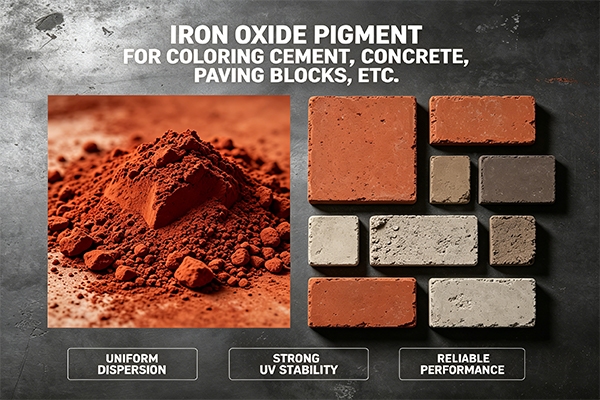
Iron oxide pigments are among the most widely used colorants for cement-based materials such as concrete, paving blocks, roof tiles, bricks, and precast elements. The most common types are:
- Iron Oxide Red (Fe₂O₃)
- Iron Oxide Yellow (FeOOH / hydrated iron oxide)
- Iron Oxide Black (Fe₃O₄)
- (and blends like brown or orange made from combinations)
Among these, iron oxide red is the most popular for architectural concrete because it gives stable, earthy tones and long-term durability.
How iron oxide pigments work in concrete
These pigments are inorganic, insoluble powders that disperse throughout the cement matrix. They do not “coat” the surface; instead, they become physically embedded in the cement paste during hydration. This makes the color:
- Permanent (won’t peel or fade easily)
- UV resistant
- Weather resistant
- Alkali stable (important in cement environments)
Applications in construction
Iron oxide pigments are used in:
- Paving blocks / interlocking bricks
- Concrete tiles and roof shingles
- Precast panels and architectural concrete
- Stamped and decorative concrete
- Cement renders and mortars
They are especially important in landscaping products where aesthetics matter as much as strength.
Typical dosage (very important)
Pigment dosage is usually calculated as a percentage of cement weight:
- 1%–2% → good shades
- 3%–5% → beautiful architectural colors
⚠️ Above ~ 8%, strength and cost efficiency may become issues without significant color gain.
Key benefits
Iron oxide pigments are preferred because they provide:
- High UV stability (no fading in sunlight)
- Excellent alkali resistance (cement-safe chemistry)
- Good dispersibility when properly mixed
- Non-toxic and environmentally stable nature
- Consistent batch-to-batch coloration (especially synthetic grades)
Factors affecting final color
Even with the same pigment, final color can vary due to:
- Cement type (gray cement darkens colors; white cement brightens them)
- Water-cement ratio
- Mixing uniformity
- Sand and aggregate color
- Curing conditions
- Pigment dispersion quality
Mixing best practices
To achieve uniform coloring:
- Dry mix pigment thoroughly with cement before adding water
- Use consistent batching and water ratios
- Avoid over-watering (causes color wash-out and weakness)
- Ensure proper vibration/compaction in pavers and blocks
- Use high-quality dispersible pigments (micronized synthetic Fe₂O₃ preferred)
Limitations to be aware of
- Cannot completely mask dark aggregates or gray cement at low dosage
- Overuse may slightly reduce compressive strength
- Uneven mixing causes streaking or mottled appearance
- Quality varies between natural and synthetic grades (synthetic is preferred)