Iron Oxides for coloring paper
Date Published
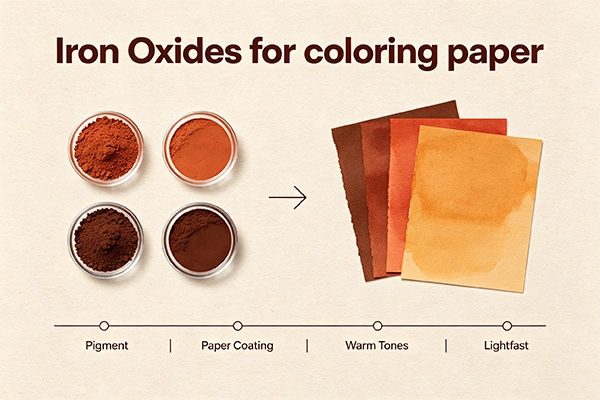
Iron oxides are widely used inorganic pigments for coloring paper, especially when you want stable earth-tone shades like yellow, red, brown, and black. In the paper industry, they’re valued for being inexpensive, lightfast, non-fading, and chemically stable.
Iron oxides typically come in a few pigment forms used in papermaking:
- Red iron oxide (Fe₂O₃): gives strong red, brick, or terracotta tones
- Yellow iron oxide (FeOOH / goethite): produces warm yellow to ochre shades
- Black iron oxide (Fe₃O₄): used for deep gray to black coloration
- Brown blends: mixtures of red, yellow, and black oxides for natural earth tones
How they’re used in paper coloring
Iron oxides are usually added during the wet-end papermaking process, meaning they’re mixed into the pulp slurry before sheet formation. There are two main approaches:
- Internal coloring (most common): pigment is dispersed directly into pulp
- Surface sizing/coating (less common for iron oxides): applied to paper surface for stronger color intensity
Key performance characteristics
Iron oxides are popular in paper because they:
- Have excellent lightfastness (won’t fade in sunlight)
- Are insoluble in water, so they don’t bleed
- Are chemically inert, so they don’t react with pulp additives
- Provide consistent earthy tones
- Are non-toxic and widely approved for industrial use
Practical formulation considerations
In papermaking, performance depends less on chemistry and more on dispersion:
- Particle size: typically sub-micron to a few microns; smaller = smoother paper surface and more uniform color
- Dispersion quality: poor dispersion leads to specking or streaks
- Retention aids: alum, cationic starch, or synthetic polymers help keep pigment in the sheet instead of draining out
- Dosage: usually low (often <5% of fiber weight, depending on shade strength desired)
Advantages vs other pigments
Compared to organic dyes or synthetic pigments:
- Much better UV stability than organic dyes
- Less risk of color migration in humid conditions
- Lower cost than many specialty pigments
- Limited brightness range (mostly earth tones, not vivid colors)
Common limitations
- Not suitable for bright cyan, magenta, or neon colors
- Can increase ash content and slightly affect paper strength if overused
- Requires good dispersion equipment (high-shear mixing often needed)