
Iron Oxides for Coloring Terrazzo
Date Published
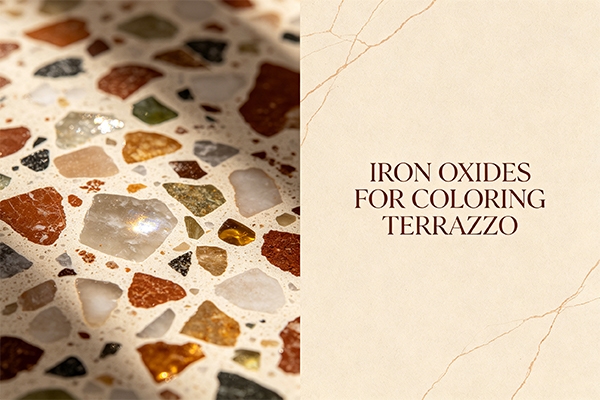
Iron oxides are one of the most common and reliable pigment families used for coloring terrazzo because they’re stable, UV-resistant, and compatible with both cementitious and resin terrazzo systems.
Common iron oxides used in terrazzo
Iron oxide pigments are typically synthetic or naturally derived mineral powders:
- Red iron oxide (Fe₂O₃) – produces brick red, terracotta, brownish reds
- Yellow iron oxide (hydrated FeO(OH)) – produces ochres, warm yellows, tans
- Black iron oxide (Fe₃O₄) – deep gray to near-black tones
- Brown blends – usually combinations of red, yellow, and black oxides
These are often sold as dry powder pigments.
Why iron oxides are preferred in terrazzo
- UV stable: won’t fade in sunlight (unlike many organic dyes)
- Alkali resistant: safe in high-pH cement environments
- Cost-effective
- Consistent color batch to batch
- Long-term durability (important for floors expected to last decades)
Typical dosage ranges
For cement-based terrazzo:
- 1% to 6% of cement weight is typical
- Most common decorative range: 2%–4%
- Going above ~6–8% can:
- weaken compressive strength
- reduce cement hydration efficiency
- cause color saturation limits (diminishing returns)
For resin terrazzo, pigment loading is usually lower:
- often 0.5%–3% of resin weight, depending on system
Color behavior tips (important in terrazzo design)
- Cement color (gray vs white) strongly affects final tone:
- White cement + iron oxide = brighter, cleaner colors
- Gray cement + iron oxide = muted, earthy tones
- Moisture content and curing conditions can shift final shade slightly darker
- Aggregates (marble, glass) visually dominate—pigment is mostly in the matrix, not the chips
Mixing best practices
- Always pre-blend pigment into dry cement before adding water
- Use mechanical mixing for uniform dispersion (avoid streaking)
- Maintain consistent batching—iron oxide is very sensitive to small ratio changes
- Keep water/cement ratio stable; excess water can “wash out” color intensity
- For large pours, batch consistency is critical to avoid panel-to-panel variation
Color design combinations in terrazzo
Common architectural palettes:
- Red oxide + white marble chips → classic Venetian terrazzo look
- Yellow oxide + limestone aggregate → warm beige institutional flooring
- Black oxide + glass aggregate → modern, high-contrast commercial floors
- Brown oxide blends → natural stone imitation effects
Compatibility notes
Iron oxides are compatible with:
- Portland cement terrazzo
- Epoxy terrazzo systems
- Polymer-modified cement terrazzo
But avoid:
- Poorly dispersed pigments (can cause speckling or streaking)
- Uncontrolled blending with organic dyes (can fade or bleed)