Iron Oxides for manufacturing epoxy floor paints
Date Published
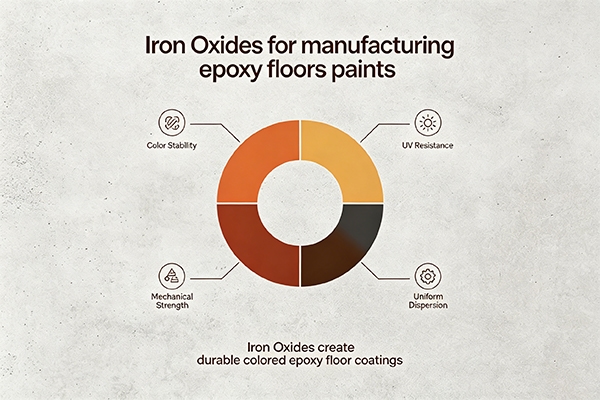
Iron oxides are among the most widely used inorganic pigments in epoxy floor coatings because they’re stable, inexpensive, UV-resistant, and available in a broad range of earthy colors (reds, yellows, browns, blacks).
A useful way to think about them in this context is as durable coloring agents rather than reactive chemicals. In epoxy systems, they simply disperse in the resin and provide long-term color stability without fading.
Common iron oxide types used in epoxy flooring
- Red iron oxide (Fe₂O₃, hematite)
The most common pigment. Produces deep reds, brick tones, and terracotta shades. Very high opacity and UV stability. - Yellow iron oxide (FeOOH, goethite-based)
Used for beige, yellow, and warm earth tones. Slightly less heat stable than red but still excellent in indoor flooring. - Black iron oxide (Fe₃O₄, magnetite)
Produces charcoal to jet-black tones. Often used for industrial-style floors or tint adjustment. - Brown iron oxide (mixed phase blends)
Pre-blended or synthetic combinations of red/yellow/black oxides for natural stone-like colors.
Why iron oxides are preferred in epoxy floors
- UV resistance: Unlike many organic pigments, they don’t fade under sunlight.
- Chemical stability: They don’t react with epoxy resins or curing agents.
- High tint strength: Small dosages achieve strong coloration.
- Low cost and wide availability
- Non-migrating: Color stays locked in the cured epoxy matrix.
Typical grades used in epoxy systems
- Synthetic iron oxides (preferred):
High purity, consistent particle size, strong tinting strength, and low contamination risk. These are standard for commercial epoxy flooring. - Natural iron oxides (less common):
Variable quality and color consistency; mostly used in lower-cost applications.
Key performance properties to look for
For epoxy floor paints, pigment quality matters more than the basic chemistry:
- Particle size (D50): typically 0.2–0.5 µm for good dispersion and smooth finish
- Oil absorption: affects epoxy viscosity and loading level
- pH stability: should be neutral to avoid resin interaction
- Moisture content: low moisture prevents curing issues
- Tinting strength: higher strength reduces pigment loading needed
Typical loading levels in epoxy flooring
- Solid color epoxy: ~3% to 10% by weight of total formulation
- High-opacity industrial coatings: can go up to 15%+
- Decorative epoxy (metallics or flakes): lower pigment load since visual effects dominate
Dispersion considerations
Iron oxides are dense and tend to settle if not properly dispersed:
- Pre-wetting in epoxy resin or plasticizer improves uniformity
- High-shear mixing is often used in industrial production
- Anti-settling additives or rheology modifiers help maintain suspension
Practical tip
For epoxy flooring, synthetic iron oxide pigments (especially red and black) are the workhorses because they combine durability with predictable behavior in resin systems. The biggest performance difference in real-world floors usually comes from particle dispersion quality, not pigment chemistry itself.