Iron Oxides for Manufacturing Wood Plastic Board
Date Published
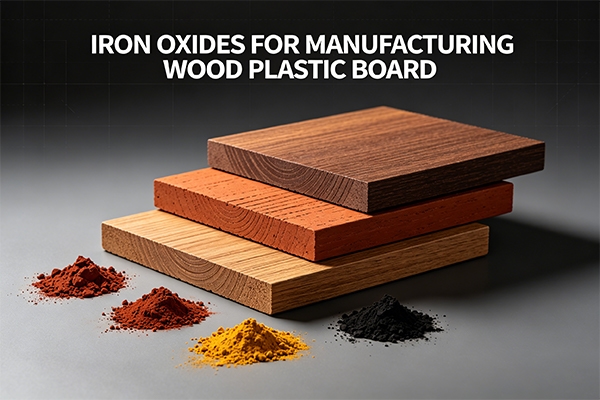
Iron oxides are widely used pigments in wood plastic composites (WPC)—including wood plastic boards, decking, cladding, and profiles—because they are thermally stable, UV-resistant, and compatible with extrusion and injection molding conditions.
Below is how they are used in manufacturing wood plastic boards.
1. Role of iron oxides in WPC boards
Iron oxide pigments provide:
- Coloring (mass pigmentation) of the entire board
- UV stabilization support (especially red and black grades)
- Aesthetic wood-tone effects (brown, tan, terracotta, gray)
- Improved weathering appearance retention
They are used for both:
- Solid-color WPC boards
- Wood-grain or co-extruded capstock layers
2. Common iron oxide types used in WPC
Red iron oxide (Fe₂O₃ – hematite)
- Produces red, brick, and brown shades
- Very stable under high processing heat
- Common in decking and outdoor profiles
Yellow iron oxide (FeOOH – goethite)
- Used for beige, tan, and natural wood tones
- Often blended with red + black for realistic wood colors
Black iron oxide (Fe₃O₄ – magnetite)
- Deepens color and improves UV resistance
- Common in dark brown, charcoal, and walnut tones
3. Why iron oxides are ideal for WPC manufacturing
WPC processing typically occurs at:
- 170–220°C (338–428°F) in extrusion
Iron oxides are preferred because they:
- Do not degrade at extrusion temperatures
- Are UV and weather stable (critical for outdoor boards)
- Are chemically inert with PE, PP, PVC matrices
- Have excellent dispersion in polymer-wood fiber blends
- Are non-migrating (no bleeding or color bleeding)
4. Typical dosage levels
Pigment levels depend on color depth and formulation:
- 1–5% by weight of polymer phase (common range)
- Dark colors: lower dosage (black iron oxide is strong)
- Light/wood tones: higher blending complexity (red + yellow + carbon black adjustments)
In masterbatch form, pigments are typically pre-dispersed at:
- 20–50% loading in carrier resin
5. Formulation approaches
A. Direct dry pigment addition
- Pigment added into compounding extruder
- Lower cost but harder to disperse uniformly
B. Masterbatch addition (preferred industrial method)
- Iron oxide pre-dispersed in PE or PP carrier
- Ensures:
- Better color consistency
- Reduced dust handling
- Improved dispersion in wood flour matrix
6. Compatibility with WPC components
WPC boards typically include:
- Wood flour / wood fiber (30–70%)
- Thermoplastic polymer (PE, PP, or PVC)
- Additives (lubricants, coupling agents, stabilizers)
Iron oxides interact well because they:
- Bind physically within polymer matrix (no chemical reaction)
- Do not interfere with coupling agents like silanes or MAPP
- Remain stable in high-moisture outdoor environments
7. Performance benefits in outdoor boards
Iron oxide pigments help improve:
- UV resistance (especially black and red grades)
- Color retention over time
- Reduced visible aging of wood fibers
- Better aesthetic consistency in recycled-content WPC
8. Typical applications
Iron oxide–colored WPC boards are used in:
- Outdoor decking
- Garden fencing and rails
- Facade cladding panels
- Park benches and street furniture
- Marine and poolside structures