
New Energy And Magnetic Materials Use Iron Oxide Pigments
Date Published
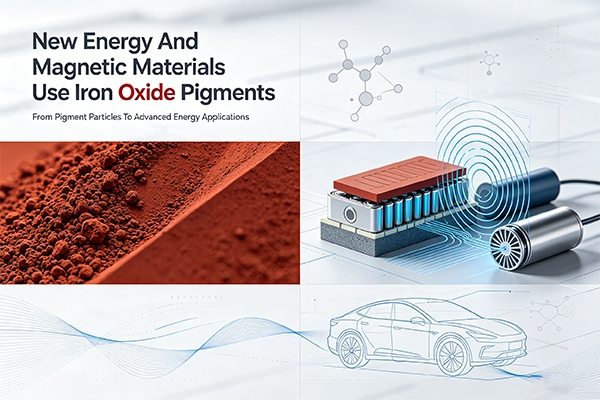
Iron oxide pigments are no longer just “colorants” (reds, yellows, blacks from compounds like Fe₂O₃ and Fe₃O₄). In modern materials science, they’re increasingly treated as functional iron-oxide materials used in both new energy systems and magnetic technologies.
Iron oxide pigment in energy applications
Iron oxides are attractive in energy systems because they are:
- Abundant and low-cost
- Chemically stable
- Environmentally benign
- Capable of reversible redox (Fe²⁺/Fe³⁺ switching)
That redox behavior is key for energy storage and conversion.
Common energy-related uses include:
- Lithium-ion battery anodes: Fe₂O₃ and Fe₃O₄ can store lithium through conversion reactions, offering higher theoretical capacities than graphite (though with challenges like volume expansion).
- Supercapacitors: Nanostructured iron oxides contribute pseudocapacitance (fast surface redox reactions).
- Photocatalysis / solar energy: Iron oxides absorb visible light and are studied for water splitting and pollutant degradation.
- Electrocatalysis: Used (often with dopants or composites) in oxygen evolution/reduction reactions for fuel cells and electrolyzers.
Magnetic materials: where iron oxides really matter
The most important magnetic iron oxide is magnetite (Fe₃O₄), which is a key building block for ferrites and spinel structures.
Key applications include:
- Ferrite magnets (e.g., Mn-Zn or Ni-Zn ferrites): Used in transformers, inductors, antennas, and EMI shielding.
- Data storage and electronics: Nanoscale iron oxides can show tunable magnetic properties useful in memory and sensing.
- Magnetic nanoparticles: Used in biomedical imaging (MRI contrast agents), drug delivery, and hyperthermia therapy.
- Spintronics research: Because iron oxides can exhibit spin-dependent electron transport.
Ferrite (magnet) and why they matter
Ferrites are engineered compounds built around iron oxide combined with metals like manganese, zinc, or nickel. They are:
- Electrically insulating (reduces eddy current losses)
- Magnetically stable at high frequencies
- Essential for modern power electronics and wireless systems
Why iron oxide pigments became “advanced materials”
What changed is not the chemistry, but the scale and structure:
- Nanostructuring increases surface area and reactivity
- Doping improves conductivity and magnetic tuning
- Composite design (carbon/graphene + iron oxide) improves cycling stability
Bottom line
Iron oxide pigments have evolved from simple color materials into multifunctional platforms for:
- Energy storage (batteries, capacitors)
- Energy conversion (solar and electrocatalysis)
- Magnetic devices (ferrites, sensors, biomedical tools)